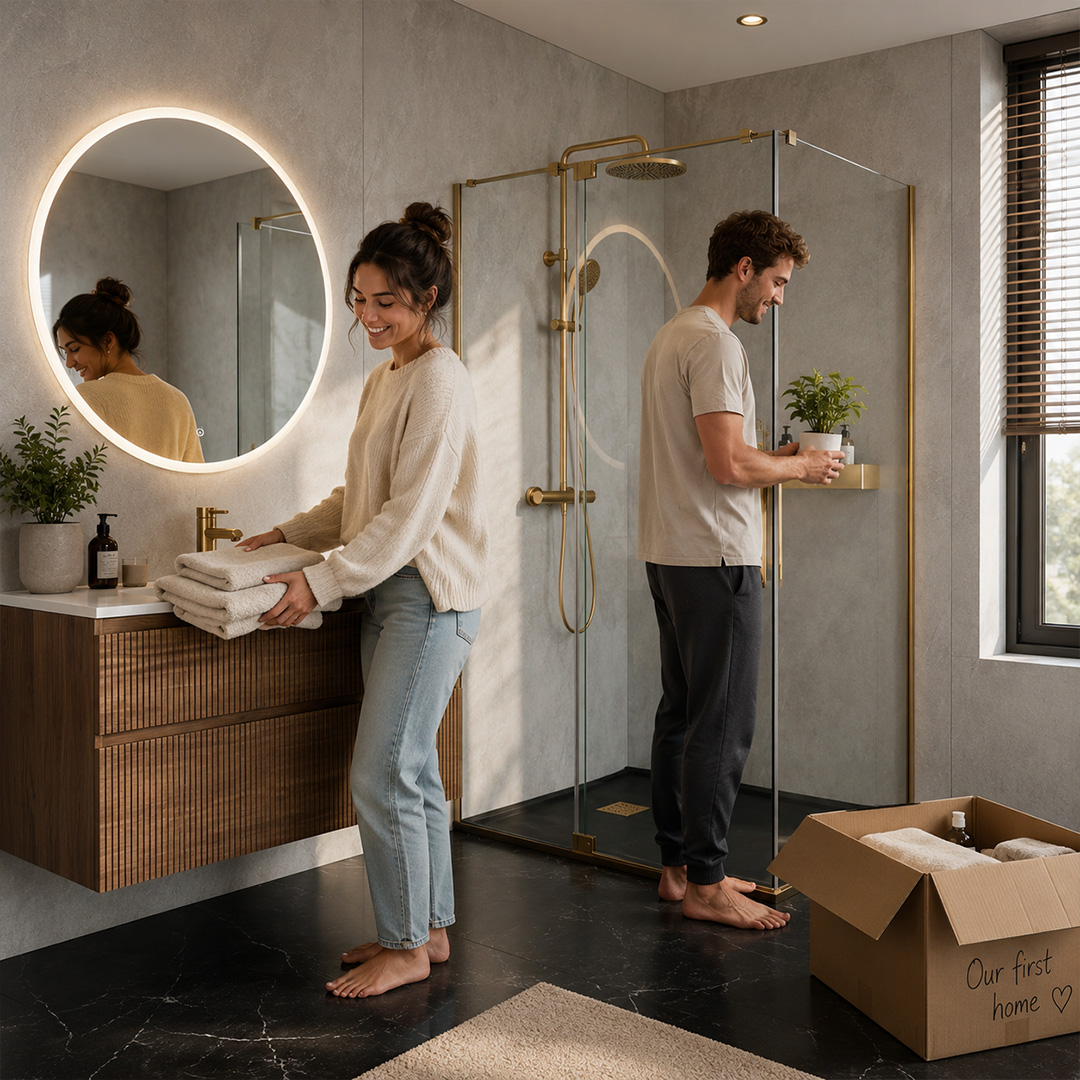
Self-adhesive wall panels for the bathroom appeal to many people because they can be installed quickly and instantly give a bathroom a fresh new look. At the same time, not every self-adhesive solution is suitable for every area in a wet room, especially where there is direct contact with water. On this page, you’ll learn what to look out for and why, during a complete bathroom renovation, people often opt for wall panels that are permanently installed over existing tiles.
Refresh Bathrooms specializes in complete bathroom, shower, walk-in shower, and toilet renovations. In these projects, plastic composite wall panels are typically installed over existing tiles, allowing for a quick bathroom renovation with minimal disruption.
When are self-adhesive wall panels a good choice for the bathroom?
Self-adhesive wall panels or wall coverings can be a good option if you’re primarily looking for a quick way to refresh the look of a bathroom wall outside of the areas subject to the heaviest wear and tear. Think of a wall that doesn’t get much direct water exposure and where the surface is flat, clean, and stable. In situations like these, ease of installation is often the main reason to consider a self-adhesive solution.
There is, however, an important distinction to make regarding wet areas: bathroom use is not automatically the same as shower use. A product may be suitable for a damp area, but it may still be less appropriate in places where there is a lot of water and frequent temperature fluctuations on a daily basis. That is precisely why it’s wise to consider not only the appearance or ease of installation, but especially the specific application for each wall—and, for example, waterproof wall panels in the shower in wet areas.
What to Keep in Mind When Using It in a Bathroom
When it comes to self-adhesive wall panels in the bathroom, these points are the most important:
- Direct contact with water – check whether the solution is actually intended for shower walls or only for damp areas outside the shower.
- Surface – The wall must be flat, dry, clean, and free of grease to ensure proper adhesion.
- Existing tiles – it is often possible to install new tiles over existing ones, but only if the tile wall is still securely attached and not too uneven.
- Seams and edges —in a bathroom, a neat and water-resistant finish is essential.
- Maintenance – A smooth surface with few grout lines is usually easier to keep clean than traditional tiling.
Those who are primarily looking for reliability in terms of durability, water resistance, and finish often opt for a professionally installed wall system rather than a purely self-adhesive consumer solution. Avoid problems with adhesion and finish; take a look at the common mistakes made during installation.
Applying Self-Adhesive Wall Panels Over Tiles
A frequently asked question is whether you can install wall panels over existing tiles. In practice, this is possible, provided the tiled wall is still in good condition. Loose tiles, deep grout lines, dirt, soap residue, or grease reduce adhesion and can cause problems later on.
When it comes to renovations, this is precisely one of the major advantages of panels: you don’t always have to tear things down first. That saves time, reduces mess, and cuts down on extra work. Refresh Bathrooms applies this principle using plastic composite wall panels that are typically installed over existing tiles as part of a complete renovation. This allows a bathroom to be quickly updated without the extensive work often associated with traditional tiling.
Self-adhesive vs. Professionally Installed Wall Panels
People who search for “self-adhesive bathroom wall panels” are often looking for a quick solution that doesn’t involve any chiseling or demolition. That’s a logical assumption. Still, it’s important to distinguish between self-adhesive wall coverings and a renovation system designed specifically for bathrooms and shower areas.
| Point of comparison | Self-adhesive solution | Interior Wall Paneling Renovation Service |
|---|---|---|
| Objective | A Quick Way to Freshen Up a Wall | Sustainable Renovation of a Bathroom or Shower |
| Application | Not every variant is suitable for areas directly exposed to moisture | Used as part of a complete renovation |
| Substrate | Highly dependent on flatness and adhesion | Will be evaluated as part of the renovation process |
| Finishing | Varies greatly depending on the product and situation | Focused on elegant, sustainable bathroom finishes |
| Nuisance | Limited, depending on the job | Quick renovation with minimal disruption |
For anyone looking to renovate an entire bathroom, the most important question is therefore not just whether a product is self-adhesive, but whether the system is suitable for long-term, daily use in a wet area.
Why Many Bathroom Renovations Opt for Panels Instead of Tiles
Wall panels are often chosen because they can give a bathroom a fresh look more quickly than traditional tiling. Especially when panels are installed over existing tiles, the renovation process remains straightforward and requires less demolition work. In addition, large panels are easy to maintain because they have fewer seams and grout lines where dirt or grime can accumulate.
For homeowners who want to modernize an outdated bathroom without a lengthy process, this aligns well with their desire for speed, cleanliness, and a sleek final result. That’s also why Refresh Bathrooms uses wall panels in complete renovations designed to minimize disruption—for those looking for an alternative to bathroom tiles.
Would this work in your bathroom?
If you’re primarily looking for a simple wall solution for a minor refresh, a self-adhesive product may be suitable for certain areas of the bathroom, provided that the product and the surface are compatible. If you’re dealing with a shower wall, a walk-in shower, or a complete bathroom renovation, it’s wiser to consider a system designed specifically for that application.
Refresh Bathrooms does not explicitly sell wall panels as a standalone product, but rather incorporates plastic composite wall panels into complete renovations. This is particularly appealing if you want to quickly update your bathroom with a neat finish over existing tiles. If you’d like to explore your options further, you can also read more about bathroom wall panels and the step-by-step guide to installing them.
Frequently Asked Questions
Can you install wall panels over tiles?
Yes, that's often possible, as long as the existing tiles are securely attached and the substrate is level, clean, and free of grease. In a bathroom, the quality of the substrate is particularly important for a durable finish.
How can you install wall panels without using screws?
Depending on the system, wall panels can be glued instead of screwed in place. The appropriate installation method depends on the type of panel, the substrate, and the location in the bathroom.
What are the best wall panels for the bathroom?
The best choice depends on the application. Various solutions may be suitable for general bathroom walls, but areas with frequent direct contact with water require a system that is specifically designed for that purpose.
What are the disadvantages of plastic wall panels in the bathroom?
The most important consideration isn’t so much the material itself, but whether the right type of panel is being used in the right place. If you choose a solution that isn’t designed for heavy wet use, it could compromise durability and finish. If you’re still unsure, be sure to also consider the drawbacks of bathroom wall panels.