
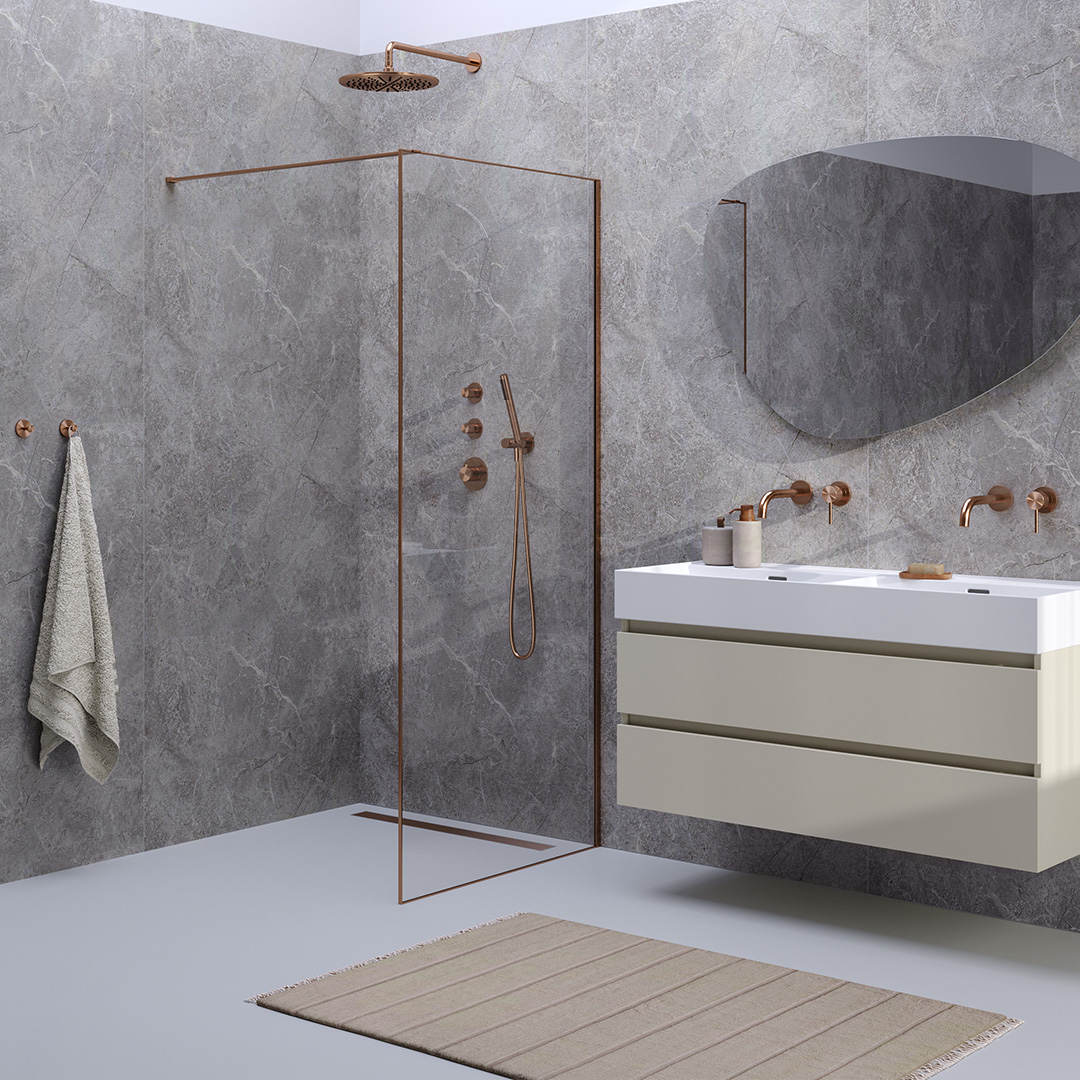
Wall panels are a popular alternative to tiles, especially if you want to renovate a bathroom quickly and neatly. However, they aren’t automatically the best choice in every situation. If you’re aware of the drawbacks of wall panels in the bathroom, you’ll be much better able to assess whether this solution suits your space, budget, and expectations.
The main considerations usually don’t lie in the concept of wall panels themselves, but in the quality of the material, the condition of the surface, and the installation method. Below, you’ll learn which drawbacks are truly relevant, when they’re a major concern, and what to look out for when making an informed choice.
Would you like to see the big picture first? Then read the overview of bathroom wall panels.
The main disadvantages of wall panels in the bathroom
1. Not every surface is suitable
A frequently underestimated drawback is that wall panels perform well only on a stable, level, and dry surface. If the wall behind them is uneven, has loose tiles, or already has moisture issues, this can lead to problems later on. These include poor adhesion, stress in the panel, or moisture trapped behind the finish.
This is especially important in renovation projects. Wall panels can often be installed over existing tiles, but that doesn’t mean the substrate no longer requires attention. You must first address damaged walls, mold spots, or loose sections. That’s why all our installers have undergone extensive training to carry out this process as effectively as possible. The idea that you can simply “quickly” stick wall panels over your existing tiling is a persistent misconception.
2. Installation errors can quickly have serious consequences
Wall panels look sleek and simple, but a mistake during installation can quickly become noticeable or cause damage later on. Panels installed crookedly, poorly finished edges, or seams that aren’t properly sealed increase the risk of moisture problems behind the panels. That’s why a specialized approach is so important. Refresh Bathrooms works exclusively with its own installation teams, which allows us to guarantee quality.
That’s why, in a bathroom, it’s not just about the panel itself, but also about the finishing touches around corners, joints, and wet areas. That’s precisely where the difference lies between a neat, durable solution and a wall that will eventually peel or develop mold. Want to know where installation often goes wrong and how to prevent it? Check out “Installing Wall Panels in the Bathroom: A Step-by-Step Guide.”
You can find practical maintenance tips and mold prevention advice in " Keeping Your Bathroom Clean and Fresh."
3. Cheap panels often don't last as long
Not all wall panels are of the same quality. Cheaper options are often more prone to discoloration, warping, or damage. In a bathroom, where temperature fluctuations and moisture exposure occur daily, you’ll notice that difference more quickly than in a dry room.
Those who choose based solely on the lowest price run a greater risk of ending up with a finish that looks less sleek after a few years. That doesn’t necessarily make wall panels a bad choice, but it does mean that the choice of material is especially important.
4. Damage is harder to repair neatly
A scratch, dent, or crack in a wall panel is often difficult to repair without leaving a visible trace. With tiles, you can sometimes replace a single tile without having to touch the rest of the wall. With panels, this is less straightforward, especially if the system uses interlocking pieces or if multiple sections fit tightly together.
This drawback is particularly significant in households where there’s a higher risk of knocks, or if you value a perfectly finished look. Even minor damage can be more noticeable in such cases. That said, it’s important to note that wall panels don’t get damaged easily. Under normal use—which is basically how you’d always use your bathroom—there’s nothing to worry about. A bottle of shower gel falling? No big deal. An electric razor falling? No problem. Kids playing with bath toys and dolls? No problem at all! The wall panels used by Refresh Bathrooms were developed exclusively for us. You can’t get them anywhere else but from us. The panels we use are extremely scratch-resistant, durable, and fit more snugly than any other wall panel.
5. The appearance isn't always the same as real tilework
Modern wall panels can look very sleek, but not everyone considers them visually on par with ceramic tiles or natural stone. Especially in the higher-end market, tiling can add more depth, texture, and a more luxurious look.
That doesn’t mean that wall panels are necessarily less attractive. However, it’s important to be realistic from the start about the difference in look and feel. If aesthetics are your top priority, this is an important consideration.
6. Limited heat resistance may be a factor
Depending on the type of panel, heat can be a concern. This is less common in the bathroom than in the kitchen, but heat sources close to the wall can still have an impact. Think of panels near a radiator or other areas where the temperature rises over an extended period.
Not every material reacts the same way to heat. That’s why it’s wise to consider not only the design but also the practical suitability for the space. Not every wall panel is suitable for the bathroom—or vice versa. Always ask what type of panel is being used or what it’s designed for. The panels developed exclusively by Refresh Bathrooms were designed with your home’s bathroom in mind.
When do these drawbacks really become a major issue?
The disadvantages of wall panels in the bathroom are particularly significant in the following situations:
- if you choose based on price rather than the quality of materials and workmanship
- if you're looking for a very luxurious, natural tile look
- if the bathroom is already dealing with moisture or ventilation problems
- if you're looking for a solution that's easy to repair, one small part at a time
Many of these risks can be minimized with a well-planned bathroom renovation. But if the foundation isn’t right, the drawbacks will become apparent more quickly.
What should you keep in mind when considering wall panels?
Can’t decide between materials? Compare tiles and wall panels for the bathroom, and don’t just look at the appearance or the price. Pay special attention to the combination of the substrate, the material, and the installation method. That ultimately determines how well the wall will hold up with daily use. Our advisors will assess the situation in your home right away during the initial consultation. This ensures that nothing can go wrong during installation by our in-house installation teams.
- Check the surface —A smooth wall or floor makes the job easier, but it’s not a strict requirement. Wall panels, in particular, allow us to effectively hide any unevenness.
- Ask what type of panel is being used —quality makes a big difference in both lifespan and appearance.
- Pay attention to the finish of seams and edges —in wet areas, proper sealing is essential.
- Evaluate samples in person —a design may look different in a photo than it does in your bathroom.
- Consider the overall renovation approach —A quick fix only works well if the preparation and installation are also done carefully.
At Refresh Bathrooms, we bring color and material samples with us during on-site consultations. This helps you avoid relying solely on a picture and allows you to truly assess the finish within your own bathroom.
So aren't wall panels a good choice?
Absolutely, but only if you weigh the options fairly. Wall panels are particularly appealing to those who want to quickly renovate a bathroom with as little disruption as possible—for example, by installing panels over existing tiles. Or for people who don’t like spending hours scrubbing their bathroom. A major advantage of wall panels is that they’re easy to keep clean and tidy. Just a cloth and the usual soapy water, and you’re done. For renovations like that , a tile-free bathroom renovation—using wall panels as a solution —can be a practical and neat choice.
The drawbacks mainly stem from unrealistic expectations and poor installation. If you expect them to look exactly like traditional tilework, choose the lowest-quality option, or fail to properly prepare the surface, the drawbacks will become more apparent. However, if you take the choice of materials and installation seriously, wall panels can actually fit well into a modern bathroom renovation without much hassle.
FAQ
Which is cheaper, wall panels or tiles?
That depends on the type of tile, the panel you choose, and the installation method. Simple tiles may be more cost-effective in terms of material cost, but wall panels can be a good option if they’re installed over existing tiles and require less demolition work. Therefore, always consider the total renovation costs, not just the price per square meter. Read more about the costs and prices of bathroom wall panels (2026).
Is wall covering a good idea for a bathroom?
Yes, wall coverings for your bathroom are always a good choice as long as they’re installed properly and professionally. Wall panels can be a smart choice for a quick renovation, but they’re less suitable if the substrate is in poor condition or if you absolutely want the look of real tilework.
How long do bathroom wall panels last?
The lifespan depends heavily on the quality of the panel, the installation, and daily use. Higher-quality panels and proper installation clearly last longer than cheaper options that are more prone to warping or damage.
What should you look for when choosing wall panels?
Pay special attention to the condition of the surface, the quality of the material, the finish of the seams and corners, and whether it’s suitable for wet areas. It’s also a good idea to see the design in person first, so you can be sure the look will match your bathroom.