
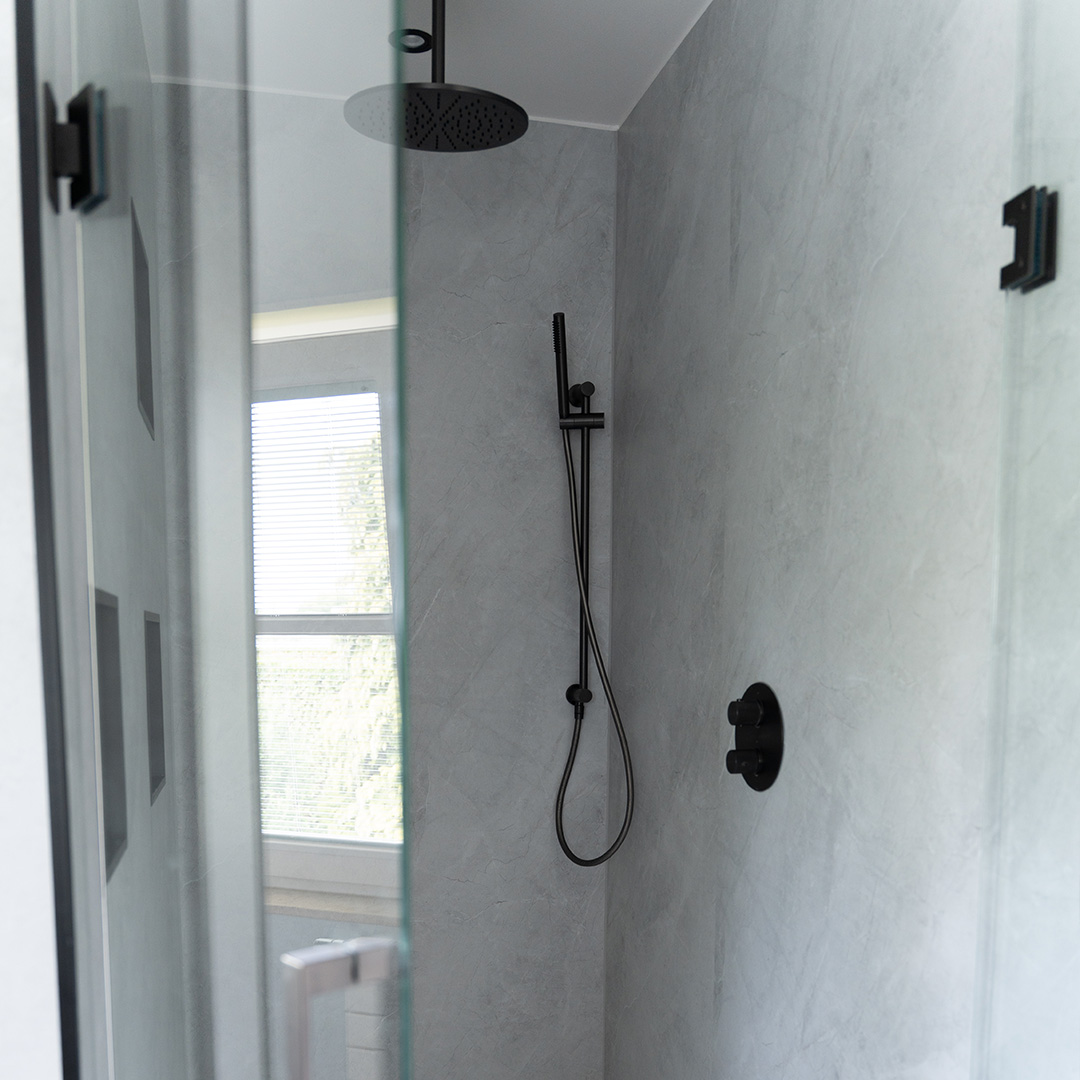
Waterproof wall panels are a practical wall finish for your shower if you’re looking for a sleek, low-maintenance, and quick renovation. At Refresh Bathrooms, we use plastic composite bathroom wall panels that are suitable for shower and walk-in shower renovations and can be installed over existing tiles. This allows you to refresh the look of your shower without the hassle of traditional demolition work.
What are waterproof wall panels for the shower?
Waterproof wall panels for the shower are large panels that are installed on the wall as a finishing layer. They offer an alternative to tiles and are used to quickly create a sleek, water-resistant finish on shower walls. Because you’re working with large panels instead of many individual tiles, there are far fewer seams—and therefore fewer places where dirt, limescale, and moisture can accumulate.
For shower applications, it is especially important that not only is the panel itself suitable for damp areas, but also that the finish is done properly. A shower wall is only reliably watertight in practice if everything works together: the panel, the substrate, the connections, and the finish. Choose panels that are suitable for the shower area; read more about the dimensions and thickness of bathroom wall panels.
Why do people choose wall panels over tiles for their showers?
The main reason is simplicity. With wall panels, you get a modern shower enclosure without the labor-intensive process of tiling, grouting, and waiting for the tiles to dry. This is especially appealing for renovation projects, since in many cases the existing tiles can be left in place.
- Fewer grout lines —easier to keep clean than traditional tiling
- Quick Renovation – Ideal for an Efficient Bathroom Renovation
- Sleek look – large panels create a calm, cohesive look
- Can be installed over existing tiles —limited demolition work and extra mess
- Suitable for wet areas – can be used in showers and walk-in showers
For many homeowners, this is particularly appealing if the bathroom is outdated but the basic structure is still usable. In that case, wall panels are a smart way to quickly modernize the space without a full-scale traditional renovation. Those who want to learn more about wall panels in the bathroom will also gain a broader understanding of their various applications and benefits.
How exactly does waterproofing work in a shower?
With waterproof shower wall panels, it’s not just about the material, but about the entire installation. The panel serves as a water-resistant finish on the visible side. In a shower environment, the seams, corners, and connections around the shower pan or floor are also particularly important. The finish must be neat and sealed in those areas to prevent water from getting behind the panels.
The substrate also plays a role. If wall panels are installed over existing tiles, the substrate must be sufficiently sturdy, clean, and suitable for a durable installation. A poor substrate remains a risk, even if the visible layer itself is water-resistant.
In short: a properly installed shower wall panel helps keep water out of the structure, but the quality of the installation and finish determines whether the system actually performs well in everyday use. Want to learn more about a watertight, jointless finish? Read more about seamless wall cladding in the shower.
What should you keep in mind when installing it in the shower?
When it comes to a shower or walk-in shower, there are a few points to consider that are more important than with a standard wall finish:
- Flat surface —unevenness can make it difficult to install the tiles neatly
- Good fit —especially in corners and where the tile meets the floor or shower pan
- Neat cutouts —for example, around faucets and shower fixtures
- Seam Sealing – Essential for Preventing Water Ingress
- Suitability of the existing situation – not every old substrate is automatically suitable
It is precisely these details that make the difference between a wall that simply looks nice and a shower wall that continues to function well over the long term. If you want to see how this is done step by step, check out the “Installing Wall Panels – Step-by-Step Guide.”
Are there any drawbacks or points to consider?
Yes, and it’s important to be honest about that. Wall panels aren’t automatically the best choice in every situation. If the substrate isn’t stable, if the joints are finished poorly, or if there’s existing moisture damage behind the wall, you won’t fix the problem by simply installing a panel over it.
It’s also true that the quality of the final result depends heavily on precise measurements, proper fitting, and correct finishing. In a space where a lot of water is used every day, it is precisely these details that make all the difference. That’s why waterproof wall panels are often chosen as part of a professional renovation project rather than as a standalone cosmetic fix.
When are shower wall panels a smart choice?
Shower wall panels are particularly appealing if you want to quickly upgrade from an outdated shower to a modern, low-maintenance finish. They’re a great fit for renovations where you want to update the space efficiently and prefer to avoid unnecessary demolition work. This also aligns with Refresh Bathrooms’ approach, where bathroom and walk-in shower renovations using panel systems are specifically designed to allow for faster updates with less disruption.
Especially in these situations, they are often a logical solution:
- When renovating over existing tiles
- If you want fewer joints and less cleaning —that also aligns with the broader benefits of wall panels
- When speed and minimizing disruption are important
- If you want a sleek, modern shower enclosure without traditional tiling
Frequently Asked Questions
What types of wall panels are available for showers?
There are various types of shower wall panels, but for this application, the most important factor is whether the panel is suitable as a waterproof wall finish for the shower. Refresh Bathrooms uses plastic composite bathroom wall panels for showers and walk-in showers in its bathroom renovation projects.
Can you install waterproof wall panels over existing tiles?
Yes, that’s possible in many renovation projects. It will only work properly if the existing tile wall is still securely attached and the substrate is suitable for installation. That’s why we first assess the condition of the current shower wall.
How do you clean shower wall panels?
A major advantage of wall panels is that they have fewer joints, making it easier to keep the surface clean. Regular cleaning prevents the buildup of soap scum and limescale. Because there are fewer seams than with tilework, maintenance usually takes less time. See also Maintenance and Cleaning of Bathroom Wall Panels.
How can I waterproof the walls in my bathroom?
When it comes to waterproofing a shower, it’s all about the entire structure of the wall: a suitable water-resistant finish, a proper substrate, and proper sealing of joints and connections. Wall panels can be an effective solution, provided they are used appropriately as part of the overall renovation of the shower wall.
Are wall panels in the bathroom always problem-free?
No. Problems usually don’t stem from the concept of wall panels itself, but rather from an unsuitable surface, careless installation, or poor finishing of edges and seams. That’s why it’s important to thoroughly assess the existing situation. For those who are still unsure, this comparison of shower wall panels and tiles offers guidance in making a choice.
Want to know if waterproof wall panels are a smart solution for your shower or walk-in shower? If so, it’s especially important to consider the existing surface, the desired look, and how quickly you want the renovation completed. Refresh Bathrooms uses these panels in complete shower and bathroom renovations, with the goal of creating a sleek new bathroom without unnecessary hassle. In this context, both a tile-free bathroom renovation and the cost of bathroom wall panels often play a key role in the decision-making process.