Installing a Washing Machine in the Bathroom
Yes, a washing machine in the bathroom can work just fine, as long as water, drainage, electricity, ventilation, and a stable foundation are properly arranged. The most important question isn’t just whether the appliance will physically fit, but also whether you’ll have enough free space for use, cleaning, and maintenance. This is especially important to consider in advance during a bathroom renovation, because then the layout and connections can be planned logically all at once.
When is the bathroom truly a smart space?
The bathroom is especially a smart choice if the basics are already in place: a logical water supply, proper drainage, safe electrical wiring, adequate ventilation, and a floor that can handle the weight and vibrations of the machine. Then the space can function efficiently, especially if you don’t have a separate utility room or find it practical to have the laundry area close to the shower and sink. However, an appliance that just barely fits isn’t necessarily convenient for everyday use.
Compared to a utility room, the bathroom often has less ventilation and higher humidity levels, while a utility room is usually more spacious and feels more practical for laundry baskets, cleaning supplies, and maintenance. In small bathrooms, the available space is even more limited. In our article “Renovating a Small Bathroom: Tips,” you’ll learn why it’s not just the location of the washer that matters, but also the walking path, the doorway, the ability to open the drum door, and the accessibility of the faucet, power outlet, and drain. If the washer blocks the doorway, the bathroom is usually not the best choice.
Checklist: These are the minimum requirements
- Make sure that water, drainage, and power are available in a logical location that remains accessible. Connections located behind a tightly fitted machine or deep inside a closed cabinet make use and maintenance unnecessarily difficult.
- The floor must be level and sturdy. If a washing machine isn't level, it's more likely to shift, vibrate more, and make more noise. You'll notice this not only during the spin cycle, but often also in the form of less effective washing results.
- Ventilation in the bathroom is doubly important: for the bathroom itself and for the air around the machine. Heat and moisture must be able to escape so that the room dries faster and the appliance doesn’t remain unnecessarily warm or damp.
- Make sure to leave enough free space around the appliance. The washing machine door must be able to open fully, and you must still be able to move comfortably around the appliance, even with a laundry basket or while cleaning the floor.
- Also consider maintenance and malfunctions. The filter, faucet, plug, and drain hose must remain accessible. If you have to take apart half the bathroom just to fix a small leak or clog, the location wasn't chosen well.
Here's how to set up the connection properly
No, you can’t just install a washing machine connection anywhere. The distance to existing water lines and the drain determines how much modification is needed and how practical the final location will be. The farther you move away from the existing plumbing, the greater the chance of additional bends, hard-to-reach connections, and a less neat finish. Always have new connections in a wet area installed safely and in accordance with the rules for electrical and safety zones in the bathroom.
For the water supply, a washing machine should be connected to its own washing machine faucet, not to just any faucet or temporary connection. This is also important for proper backflow protection. For the drain, a 40 mm pipe is usually used; it’s best to avoid anything smaller. The drain must also be installed at the correct height, and the drain hose should be kept as short and straight as possible, according to the manufacturer’s specifications. A hose that is too long or routed awkwardly increases the risk of malfunctions, poor drainage, and water-related issues. Would you like to have this done professionally and neatly? Then choose Bathroom Installation.
Bathroom Safety: Watch Out for Vibrations, Moisture, and Heat
During the spin cycle, the floor has to withstand more stress than many people realize. The weight of the appliance, the water, and the movement of the drum all combine to cause significant vibrations. Especially on a wooden floor or when the machine is stacked on top of another, it must be stable and level. Less vibration means not only greater comfort, but also less noise, less wear and tear, and less disruption in the home.
A damp bathroom doesn’t have to be a problem, as long as heat and moisture are properly vented and the machine has adequate ventilation space. So pay attention not only to the connection but also to stable placement, easily accessible utilities, and air circulation around the appliance. A washing machine doesn’t just catch fire out of the blue, but a defective appliance, a damaged cord, or a lack of ventilation makes any electrical appliance less safe. A dry, accessible, and well-ventilated spot is therefore always the best choice.
Which layout works best in your bathroom?
Are you looking for specific layout advice for a compact space? Then check out the 4 m² bathroom layout for a detailed example.
| Lineup | Goes well with | Please note the following |
|---|---|---|
| Detached | Bathrooms with plenty of open floor space | Measure the appliance dimensions, the door opening, the delivery route, and the space required for the door, hose, and ventilation |
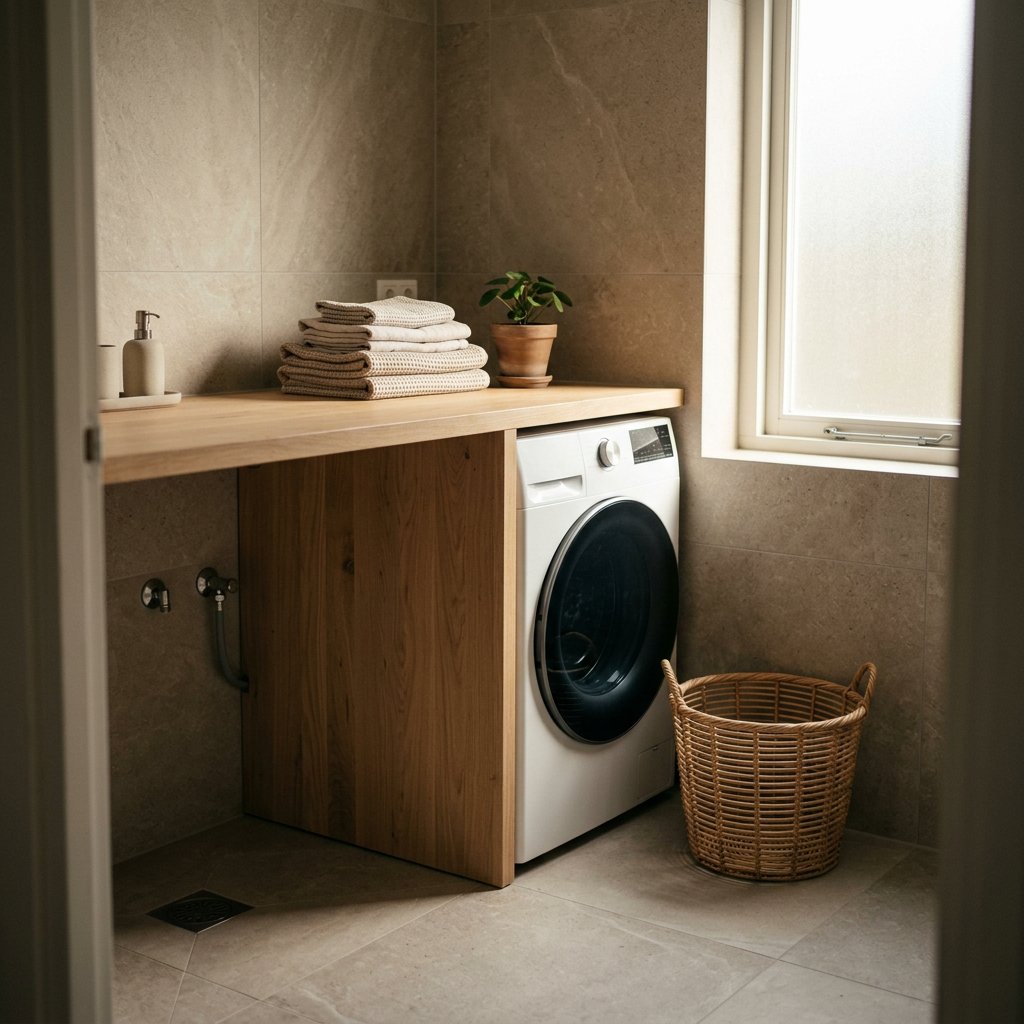
| Under a leaf | For those who want extra workspace and a serene atmosphere | Be sure to check the blade height, depth, clearance behind and above the machine, and accessible connections |
| In a niche | Straight walls or a dead corner | Adjust the dimensions precisely and allow room for vibrations, hoses, and maintenance |
| Stacked with a dryer | Small bathrooms with limited floor space | Check the height, load-bearing capacity of the floor, and ensure a stable setup |
| Hidden inside a piece of furniture | A sleek, serene bathroom look | Never build it too cramped; ensure there is ventilation and access to the electrical outlet, faucet, and drain |
Combining a Washing Machine and Dryer: What Works and What Should Be Avoided?
A dual faucet or splitter can be convenient if you have two appliances that each use their own water supply, but this isn’t the case for every dryer. The downside is that you have fewer options for shutting off the water separately, and this type of solution isn’t always the neatest or most future-proof choice. So always consider the type of appliance and the quality of the connection.
If your dryer has a condensate drain, using a single shared drain is not generally recommended. This is only possible if the diameter, height, and capacity are suitable for both appliances and the setup is safe. Are you unsure whether to stack them or place them side by side? Stacking saves floor space but places greater demands on height and stability. Placing them side by side is often more convenient for everyday use, although it requires more width.
Are you planning to renovate the bathroom anyway? If so, be sure to include the washing machine in your plans right away.
If you’re renovating the bathroom anyway, this is the best time to plan the location of the washing machine right from the start. With a complete bathroom renovation—which costs between €12,500 and €15,000 on average—you don’t want to have to compromise on walking space, storage, or plumbing later on. A niche, countertop, or subtle finish can seamlessly integrate the machine into the overall design, as long as ventilation and access for maintenance remain unobstructed.
At Refresh Bathrooms, we therefore review the entire layout in a single plan during a consultation about your bathroom—from placement and connections to a practical, neat finish. Especially in smaller bathrooms, planning ahead prevents situations where a door no longer opens properly, a fixture is too cramped, or valuable space is lost.