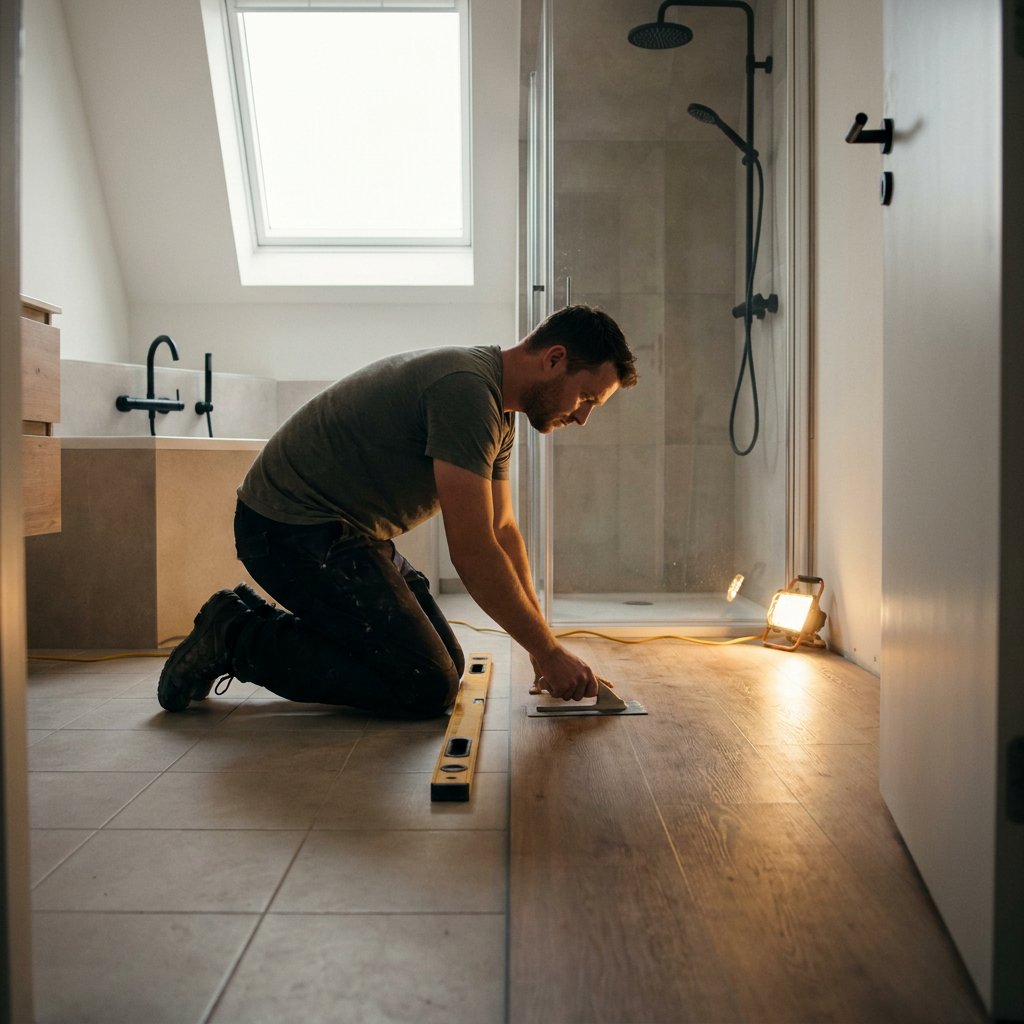
PVC flooring in the bathroom over tiles
Installing PVC flooring over tiles in the bathroom is possible in many situations, but only if the existing tile floor is level, stable, and properly prepared. For homeowners who want to quickly update and renovate their bathroom without any breaking or demolition work, this is a logical option to consider. At the same time, it’s important to know in advance what the limitations are, especially in wet areas and when finishing along edges and joints.
Anyone renovating a bathroom usually wants to minimize disruption, achieve a sleek look, and find a solution that remains practical for everyday use. That’s precisely why it’s not just the choice of flooring that matters, but also the subfloor, the type of PVC, and how the floor is finished. With the right approach, you can prevent minor imperfections or moisture issues from becoming major problems down the road.
Can PVC flooring be installed directly over tiles in the bathroom?
Yes, that’s often possible, but not in just any bathroom and not on every tile floor. The existing tiles must be securely fastened, and the subfloor must be sufficiently level. If there are differences in height, deep grout lines, cracks, or loose tiles, these issues must be resolved first before a PVC floor can be installed neatly and durably.
A major advantage is that old tiles don’t always need to be removed. That saves time, reduces dust, and avoids unnecessary demolition work. This is particularly appealing during a complete bathroom renovation, because it allows you to achieve a new look more quickly without having to tear the entire space apart.
When is a tile floor suitable as a subfloor?
The subfloor determines whether installing PVC flooring over tiles in the bathroom is really a good choice. These are the most important requirements:
- Surface: PVC requires an even surface. Otherwise, unevenness and deep joints may remain visible or noticeable.
- Stable: Tiles that sound loose or hollow do not provide a good foundation for a new floor.
- Clean and dry: Grease, soap residue, dust, and moisture can negatively affect adhesion or the finish.
- Free of damage: Cracks, damage, and sagging must be repaired first.
In practice, this often means that preparation is more important than the floor itself. An existing tile floor can serve as a perfectly good base, but only if it is structurally sound.
Install adhesive PVC or click-together PVC over bathroom tiles
When installing flooring over tiles in a bathroom, the difference between adhesive PVC and click-lock PVC is important, because the two systems have different requirements for the subfloor.
PVC Sheet
PVC sheet is glued to the subfloor and therefore requires a very level surface. On an existing tile floor, this usually means that the floor needs to be leveled to eliminate grout lines and minor height differences. The advantage is a smooth finish with a low installation height.
Click PVC
Click PVC may be slightly more forgiving in some situations, but even here, a good subfloor remains important. Minor unevenness isn’t automatically a problem. In a bathroom, it’s also important to pay extra attention to seams and edges to prevent moisture from getting under the floor.
Which option is best, therefore, depends not only on appearance or personal preference, but above all on the condition of the tile floor and the requirements of the space.
Important limitation: not for the shower area itself
A common misconception is that “water-resistant” means the flooring is suitable for any wet area. That is not the case. A PVC floor may be suitable for a bathroom floor, but it is not automatically the right choice for the shower area itself, where the exposure to standing and direct water is much higher.
For the part of the bathroom outside the shower, PVC can be a practical solution, provided the floor is properly installed and finished. In the wettest area, the requirements are simply more stringent. That’s why it’s wise to always consider the shower floor and the rest of the bathroom separately. If you want extra assurance regarding traction and safety, check out the anti-slip solutions for showers and bathrooms.
Why choose PVC over tiles in the bathroom?
If the subfloor is suitable, installing PVC flooring over tiles offers a number of clear advantages:
- Less demolition work: existing tiles do not always need to be removed.
- Less disruption: less dust, debris, and clutter during the renovation.
- Faster renovation: The bathroom gets a fresh new look more quickly.
- Ease of Maintenance: A PVC floor is easy to keep clean.
- Comfort: PVC often feels warmer and more comfortable than a hard tile floor.
For many people, the decision comes down mainly to renovating smartly: achieving a modern look without undertaking unnecessarily extensive work.
Points to Consider Regarding Moisture and Finishing
In a bathroom, it’s not just the floor that’s important—the finishing touches are just as crucial. Transitions along the walls, connections to plumbing fixtures, and other edges must be finished neatly and made moisture-resistant. This reduces the risk of water seeping under the floor.
Daily use is also a factor. Splashes are different from prolonged exposure to water. That’s why a PVC floor in the bathroom must always be evaluated in the context of the space: where does water come from, how intensively is the bathroom used, and what is the construction of the existing floor?
Caring for a PVC Bathroom Floor
One of the practical advantages of PVC is that it’s relatively easy to maintain. In most cases, regularly removing dust and dirt and mopping the floor is enough to keep it looking neat. Because there are fewer grout lines than with a traditional tile floor, the floor often looks cleaner and more uncluttered.
However, it’s still a good idea not to let water sit on the floor for longer than necessary. After all, a bathroom is a humid space, and a good daily routine helps keep the floor looking nice for longer.
Would this work for your bathroom renovation?
Anyone looking to renovate a bathroom without unnecessary demolition work often starts by considering solutions that can be applied over existing tiles. That makes sense, especially when speed, convenience, and minimizing disruption are important. At the same time, the technical foundation must be right: not every tile floor is automatically suitable for a PVC finish.
At Refresh Bathrooms, the focus is on complete bathroom and toilet renovations with as little disruption as possible. This includes installing walls with plastic composite panels, such as bathroom wall panels over tiles. If you’d like to learn more about material choices for wet areas, read on to learn about PVC panels in the bathroom. When it comes to flooring solutions as part of a complete renovation, it’s therefore wise to have each bathroom assessed individually to determine which construction method and finish best suit the existing situation.
Frequently Asked Questions
Can I install PVC flooring in the bathroom directly over tiles?
This is often possible, but only if the tile floor is level, stable, clean, and dry. If there are deep grout lines, loose tiles, or obvious unevenness, preparatory work is required first.
Can I install PVC flooring over tile?
Yes, PVC flooring can be installed to meet existing tile surfaces or other finishes, but those transitions must be finished neatly and made moisture-resistant. In a bathroom, this transition is especially important for preventing moisture from seeping in.
How much does it cost to install PVC flooring over tiles?
The cost depends on more than just the floor itself. In particular, the condition of the existing tile floor, the preparation required, and the finishing touches account for a large part of the total cost. That’s why a price quote without an assessment of the subfloor is often unreliable.