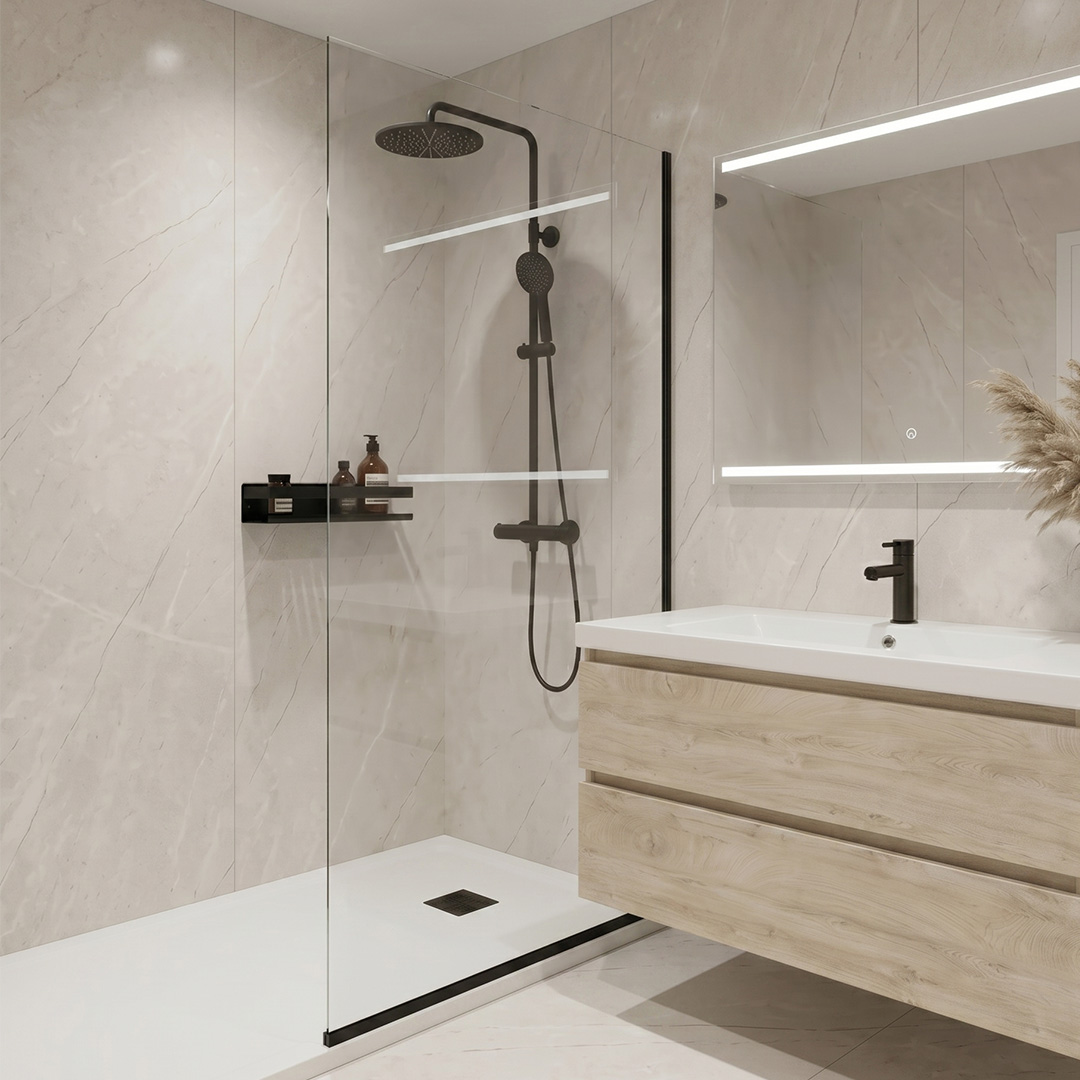
Are you looking for bathroom wall panels that create a quieter and more comfortable environment? If so, it’s important to understand what bathroom wall panels can realistically achieve. In a room with hard surfaces such as tiles, glass, and bathroom fixtures, wall panels primarily help reduce reverberation and harsh reflections, while also providing a sleek and low-maintenance finish. Material composition and thickness play a role here; see also Dimensions and Thickness of Wall Panels.
At Refresh Bathrooms, wall panels are a standard feature of bathroom and toilet renovations. They are used as an alternative to tiles and can also be installed over existing tiles, which is ideal for a quick renovation with minimal disruption.
How Bathroom Wall Panels Help with Sound
In practice, people often use the search term “soundproofing bathroom wall panels” when looking for ways to make their bathroom quieter. It’s important to distinguish between two effects:
- Less echo in the bathroom —sound doesn't seem as loud, sharp, or hollow within the room itself.
- Less sound transmission to other rooms —sound travels less easily into adjacent rooms.
Wall panels in the bathroom are primarily chosen for their neat finish, ease of maintenance, and quick installation. In a bathroom with many hard surfaces, they can also help create a more pleasant acoustic experience in the space. This includes less harsh echo from voices, a less “hollow” sound, and a quieter overall environment while the bathroom is in use.
For effective sound insulation between rooms, more is usually needed than just the wall’s surface finish. The substrate, the entire wall structure, and the connections around pipes and penetrations also play a major role. The quality of installation is also crucial for preventing hollow sounds or resonance; therefore, be on the lookout for common mistakes and gaps: Mistakes in the installation of bathroom wall panels.
When Wall Panels Are a Good Choice for the Bathroom
Bathroom wall panels are a particularly logical choice if you want to renovate a bathroom while also improving its comfort. They are especially useful in the following situations:
- The bathroom echoes loudly because of all the tiles and smooth surfaces.
- You want to get rid of grout and have a low-maintenance wall finish
- You want to renovate quickly without lengthy demolition work
- You want to have panels installed over existing tiles
- You're looking for an attractive solution for the walls in a shower or walk-in shower
If you’re primarily bothered by echoes and a reverberant sound in the room, you’ll generally benefit more from a smart renovation choice involving suitable wall finishes than from expecting complete soundproofing. If you’re ready to get started on this, check out the practical guide: Installing Wall Panels: A Step-by-Step Guide.
Are wall panels suitable for damp areas?
Yes, bathroom wall panels are specifically designed for wet areas such as the bathroom, shower, and walk-in shower, provided you choose panels that are suitable for these areas and have them installed correctly. Refresh Bathrooms uses plastic composite panels as an alternative to tiles in bathroom and toilet renovations. You can read more about the material composition in “Composite Wall Panels: An Explanation.” In addition, there are high-density variants that offer superior impact and moisture resistance; read more in “SPC Wall Panels in the Bathroom.”
This makes them ideal for people who are not only looking for a quieter experience, but also want a practical solution suitable for everyday use in a humid environment.
What You Shouldn't Expect from Wall Panels Alone
People searching for “soundproof bathroom wall panels” sometimes expect that noise from the shower, voices, or the use of bathroom fixtures will be immediately and effectively blocked. That expectation is usually too high when it comes solely to the visible wall covering.
Wall panels alone usually do not completely dissolve:
- structure-borne noise transmitted through pipes or the building structure
- sound that escapes through the floor, ceiling, or door
- Sound transmission to adjacent rooms through the entire wall assembly
- Noise from plumbing or mechanical systems
That's why it's wiser to view wall panels as part of a comfortable bathroom finish, rather than as a standalone guarantee of complete soundproofing.
Why This Topic Comes Up So Often in Bathroom Renovations
When renovating a bathroom, many people consider not only aesthetics but also everyday comfort. A bathroom that doesn’t echo as much, can be finished more quickly, and is easy to keep clean immediately feels more pleasant. That’s precisely why wall panels are increasingly being considered as an alternative to traditional tiling.
For Refresh Bathrooms, this fits perfectly within their renovation approach: a complete bathroom remodel using high-quality panels, carried out quickly and with minimal disruption. This is particularly appealing to those who want a modern bathroom without a long and extensive renovation process.
FAQ
What are sound-absorbing wall panels?
These are wall panels that help improve the acoustics in a room, for example by reducing echo or reverberation. In a bathroom, the main goal is to create a more pleasant sound within the room itself, not necessarily to completely block sound from reaching other rooms.
Are acoustic wall panels moisture-resistant?
Not every acoustic panel is suitable for wet areas. For a bathroom, it’s important to specifically choose wall panels that are designed for damp environments. Refresh Bathrooms uses plastic composite wall panels for bathroom and toilet areas as part of bathroom renovations.
What are the disadvantages of acoustic wall panels in a bathroom?
The most important point to keep in mind is that not every panel is suitable for damp conditions. In addition, you shouldn’t confuse sound attenuation with complete sound insulation. If your main goal is to limit sound transmission to other rooms, you’ll often need more than just a wall panel.
What are some alternatives to acoustic wall panels?
If your main goal is a quick, low-maintenance bathroom renovation, moisture-resistant wall panels are often chosen as an alternative to tiles. If, on the other hand, your main goal is maximum sound insulation, you’ll usually need to take a broader look at the entire wall, floor, or ceiling situation.