How many watts of heating does your bathroom need?
There is no standard wattage for every bathroom: the volume of the space, heat loss, and desired comfort level determine the required capacity. Heating the entire room requires a different approach than simply heating towels or providing localized supplemental heating. At Refresh Bathrooms, we’ll help you get started with bathroom advice: begin with a rough calculation and then compare the result with the heat output under your actual usage conditions.
Start with the contents of your bathroom
- Measure the length, width, and ceiling height of your bathroom in meters.
- Calculate the volume: length × width × height = volume in m³.
- Don't just consider the floor area. Two bathrooms with the same square meterage will have different volumes depending on their ceiling heights, and thus a different starting point for the power calculation.
A lower ceiling reduces the volume of the room; consider whether lowering the ceiling in the bathroom might reduce the required capacity.
Use a calculation factor for an initial estimate
This simplified, single-source estimation method provides a general indication; it is not a universally applicable technical standard or a guaranteed minimum power rating.
| Number of exterior walls | Calculation Factor | Total power in watts |
|---|---|---|
| None | 55 W/m³ | Volume × 55 |
| One | 65 W/m³ | Volume × 65 |
| Two | 75 W/m³ | Volume × 75 |
Calculation example: a 15 m³ bathroom
For a 15 m³ bathroom with one exterior wall, this method uses a factor of 65 W/m³. The calculation is 15 × 65 = 975 watts. This is the power estimate for this example scenario, not the standard recommendation for every small bathroom.
Check which factors affect your heating needs
- Insulating walls, roofs, and floors reduces heat loss. Window surface area and the type of glazing also play a role. Learn more about insulation with bathroom wall panels.
- A warmer bathroom requires more power than a cooler bedroom. Moreover, heating a room quickly requires a different approach than maintaining the temperature.
- Ventilation removes both heat and moisture. Understand the importance of ventilation in the bathroom.
- An accurate calculation evaluates these circumstances together, without arbitrarily stacking surcharge percentages.
Compare radiators and other bathroom heating options
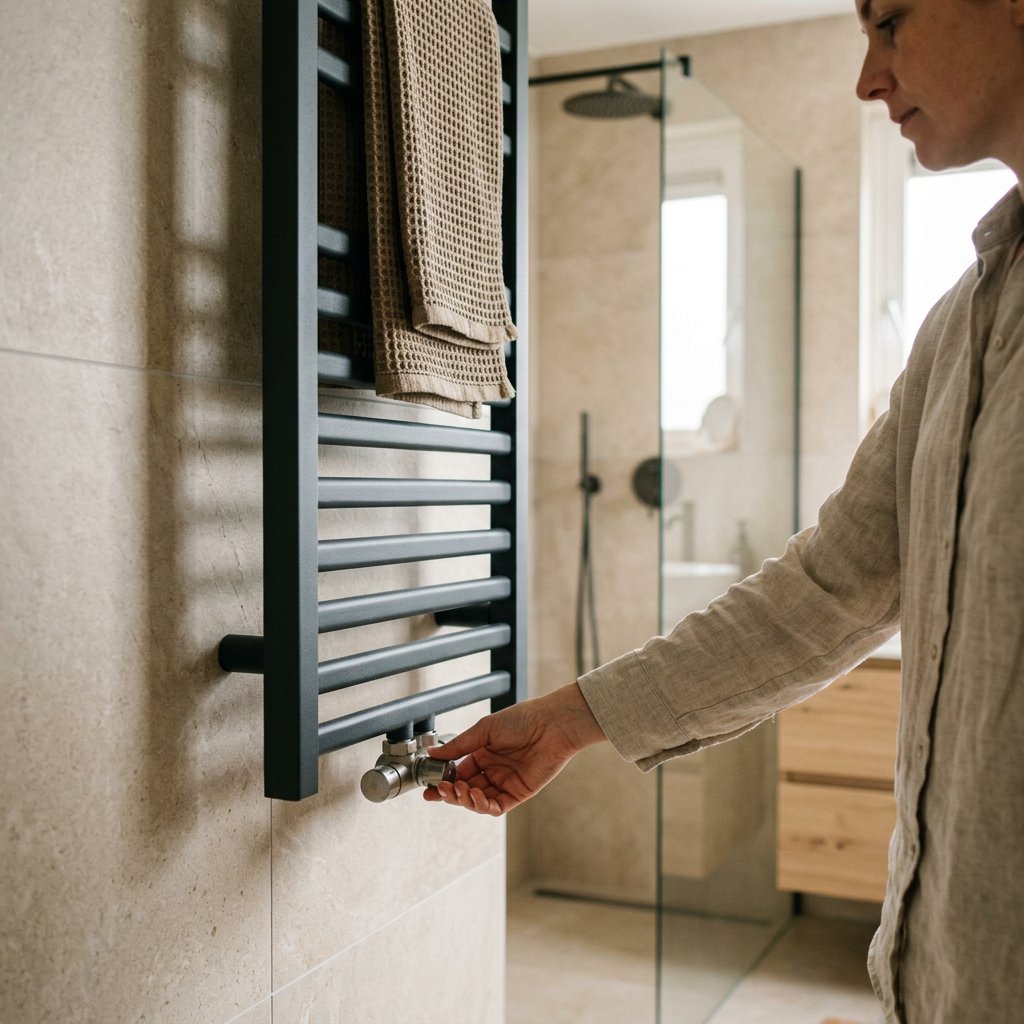
The energy source does not affect the heating requirement. An electric radiator must therefore be suitable for either primary or supplemental heating. For towel and designer radiators, size, shape, and towel space do not guarantee that the heating capacity is sufficient.
| Type | Connection | Heat Output and Applications | Drying Towels |
|---|---|---|---|
| Central heating radiator | Central heating water | Convection and radiation; primary heating when heat output is sufficient | For the towel model |
| Electric radiator | Electricity | Convection and/or radiation; primary or supplemental heating, depending on capacity | For the towel model |
| Hybrid radiator | Central Heating Water and Electricity | Central heating or electric heating; capacity varies depending on the operating mode | For the towel model |
| Infrared Panel | Electricity | Directional radiation; primary or supplemental heating requires appropriate radiation coverage | For models designed for that purpose |
| Floor Heating | Water or electricity | Primary or supplemental heating; responds more slowly with a heavy floor structure | No |
Check the radiator capacity for a heat pump
The specified radiator output applies to specific supply, return, and room temperatures. At lower water temperatures, the same water-filled radiator emits less heat. This does not change the bathroom’s heat demand.
Therefore, compare the required capacity with the product specifications for the intended operating temperatures of your heat pump. A larger heat-emitting surface or a suitable low-temperature solution may be necessary. A fixed multiplier for each radiator does not account for these varying conditions.
How much does one hour of electric bathroom heating cost?
Watts represent power; kWh represents electricity consumption. For continuous heating, the formula is: watts ÷ 1,000 × hours of use = kWh. Multiply that consumption by your electricity rate to calculate the cost.
A 1,000-watt appliance consumes 1 kWh in one hour at full power. Assuming a rate of €0.30 per kWh, that costs €0.30. A thermostat can turn off the heating element as soon as the set temperature is reached: so one hour of operation does not automatically mean one hour at full power.
Which is cheaper: central heating or an electric space heater?
Compare costs per kWh of heat supplied, including efficiency. Using the system to provide supplementary heat while the central heating is running is different from simply heating the bathroom briefly outside the heating season. Furthermore, a heat pump yields different results than direct electric resistance heating. Targeted, time-controlled heating limits the operating time, but makes a unit with insufficient capacity unsuitable as the primary heating source.
Have bathroom heating installed safely
- Where an appliance may be installed near a bathtub or shower depends on the electrical and safety zones in the bathroom, the electrical protection class, and the specific appliance's instructions.
- An IP rating indicates protection against the ingress of water and solid objects. This rating alone does not prove that any device can be mounted or placed anywhere.
- A qualified electrician will determine the appropriate connection method, any circuit requirements, and safe installation. A freestanding electric heater should not simply be placed next to the shower.
- Adequate heating capacity and a safe installation are separate requirements: the correct wattage does not make an improper setup safe.
Consider heating capacity as part of your bathroom renovation
A heat loss calculation for each room determines the required capacity in watts. Keep this information on hand for future adjustments, such as installing a heat pump. Adapt the heating system to the new layout and the available wall and floor space.
We’ll take care of your bathroom renovation using durable, waterproof composite panels in 1–3 days. The average price for a bathroom ranges from €12,500 to €15,000.