Noise Disturbance During a Bathroom Renovation in an Apartment
When renovating a bathroom in an apartment, noise pollution is often the biggest concern. That makes sense: walls, floors, shafts, and pipes are all close together, so the sounds of demolition, drilling, and drainage carry more easily than in a single-family home. Temporary disturbances during working hours usually can’t be completely avoided, but a persistent increase in shower, drainage, or impact noise after the renovation is a different matter. In that case, something may have changed structurally. Below, you’ll learn where the noise usually comes from, what rules often apply in an apartment, and how to minimize disturbances for yourself and your neighbors as much as possible.
Where the extra noise usually comes from
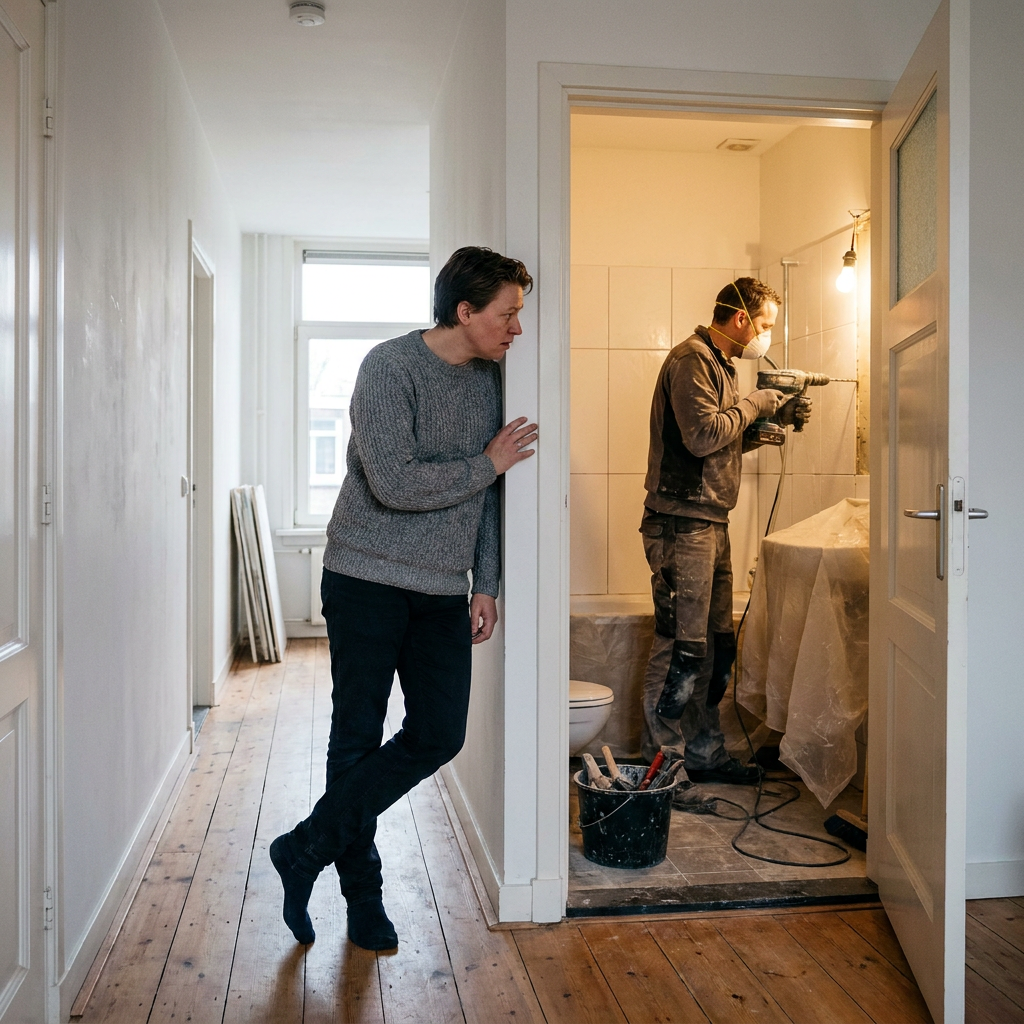
Most noise disturbances occur in two phases. First, there’s the renovation itself: removing tiles, drilling, adjusting plumbing, and bringing in and hauling out materials. Afterward, if the bathroom is structured differently than before, you may notice a persistent increase in noise. Think of a drain that’s closer to the partition wall, a vertical pipe that hasn’t been properly isolated, or a shower floor that transmits vibrations directly to the building structure.
| Situation | What You Often Hear | Common cause |
|---|---|---|
| Demolition and Chopping | Drilling, pounding, vibrations | Temporary demolition work |
| Pipes moved to a shared wall | Running water, dripping, drain | Noise is closer to the property line |
| Drain or downspout securely fastened | Rumbling or resonance | Insufficient acoustic decoupling |
| Open shaft or poor feed-through finish | Echo, voice, extra reverb | Sound leakage through a shaft or opening |
After the renovation, do you suddenly hear a lot more noise from the shower, the drain draining, faucets, or even voices coming from your neighbors’ bathroom? In that case, it’s not just the volume of the noise that matters, but also the type of noise. That’s often what helps pinpoint the source of the noise.
What is and isn't allowed during a bathroom renovation in an apartment?
Homeowners' Association Rules and Working Hours
When buying an apartment, you should always first review the homeowners’ association (VvE), the by-laws, and the deed of division. You’re often allowed to do a lot within your private living space, but as soon as a renovation affects pipes, shafts, floors, load-bearing elements, or other common areas, permission or coordination may be required. See also: Do You Need a Permit to Renovate a Bathroom? Fixed working hours often apply to noise disturbances. These vary by homeowners’ association and municipality, but noisy work is usually permitted only on weekdays during the day. Evenings, Sundays, and holidays are often restricted or prohibited.
Common Areas, Water, and Damage
It’s not just noise that matters. The stairwell, elevator, hallway, and temporary water shutoffs also play a role. Materials or debris in common areas are often not allowed to remain, partly due to safety and fire hazards. Proper planning and timely notification of nearby residents prevent most annoyances. Want to coordinate realistically with the homeowners’ association and neighbors? Read: How long does a bathroom renovation take?
When is a nuisance considered normal, and when is it not?
Temporary inconvenience during a bathroom renovation is normal as long as it is limited in duration, takes place during reasonable working hours, and is clearly communicated in advance. This is especially true for the first phase, when demolition or drilling is taking place. It becomes less normal when:
- people work hard outside of scheduled hours,
- the renovation is taking an unnecessarily long time without a clear schedule,
- common areas become structurally blocked,
- after completion, significantly more water or impact noise remains audible than before.
The latter, in particular, is more often indicative of a technical issue than of ordinary household noises.
What can you do if the noise persists after the renovation?
If your neighbors' bathroom suddenly lets in a lot more noise after a renovation, it's a good idea to systematically check what has changed. The more specific you are, the greater the chance of finding a quick solution.
- Write down what sound you hear: the shower, the drain, a tapping sound, voices, or vibrations.
- Make a note of when it happens and whether it was like that before the renovation as well.
- Calmly discuss with your neighbors exactly what changes have been made to the layout, drainage, or plumbing.
- Check whether the homeowners' association should have been involved in technical modifications.
- If problems persist, have a technician inspect the shafts, pipe fastenings, penetrations, and the connections to the wall or floor.
Sometimes the solution is relatively simple, such as disconnecting a pipe or better finishing the opening around a penetration. If it remains unclear where the noise is coming from, a structural or acoustic specialist can help pinpoint the source of the noise transmission.
Here's how to minimize noise disturbances for your neighbors
If you’re planning to renovate your bathroom in an apartment yourself, there are many things you can do to minimize disruption. The biggest benefits usually come from a tight schedule, less demolition work, and clear communication. Want to know specifically how you can reduce noise through your choice of materials? Read more about noise and insulation for bathroom wall panels.
- Notify neighbors and the homeowners' association in advance of the start date, work hours, and duration.
- Concentrate noisy work as much as possible into a short period of time.
- Whenever possible, opt for a bathroom renovation without demolition or dismantling to minimize demolition.
- Consider using wall panels over tiles for a quick finish to avoid demolition and minimize installation noise.
- Make sure that pipes, shafts, and penetrations are finished neatly.
- Keep the hallway, elevator, and stairwell clear of debris and materials.
At Refresh Bathrooms, the focus is on fast and tidy renovations. Complete bathroom renovations are completed in 1 to 3 days, using sustainable materials and a method that helps minimize major demolition and mess. As a result, not only is the renovation time short, but so is the period during which neighbors may be inconvenienced. In addition, you know exactly what to expect from the start thanks to transparent pricing and a comprehensive approach that covers everything from consultation to project completion.
Frequently Asked Questions
What are neighbors' rights when renovation work causes a nuisance?
Neighbors do not have to accept all nuisances. They are entitled to expect that work will be carried out within a reasonable time frame, that common areas will remain safe, and that unnecessary disturbances will be avoided. In an apartment building, the rules set by the homeowners’ association often serve as a guide in this regard.
What can I do about noise from my neighbors caused by a renovation?
Start the conversation by specifically describing what noise you hear and when it occurs. Then check the homeowners’ association’s bylaws. If the problems persist, you can contact the board, the property manager, or a specialist.
What are the time restrictions on noise during a renovation?
There is no fixed national schedule that applies uniformly everywhere. Work hours are often limited to weekdays during the day, with restrictions in the evening and on weekends. Therefore, always check the homeowners’ association rules and local regulations.
Is it normal to hear more noise from the shower or drain after a bathroom renovation?
A slight change is possible, but it’s not necessarily the case that there will be significantly more noise than before the renovation. This could indicate that a drain, pipe, or shaft is now transmitting the noise more strongly to the wall or floor.
Do I need to notify my homeowners' association about a bathroom renovation?
In many apartment buildings, this is a good idea and sometimes even required—especially if the renovation affects pipes, shafts, floors, work hours, or common areas. Letting people know in advance prevents disputes later on and makes the schedule clearer for everyone.
What's the most effective way to reduce noise pollution in your apartment?
The best approach combines a short turnaround time, minimal demolition work, good communication, and technically sound execution. Piping, drains, and feed-throughs, in particular, deserve extra attention, as they are often the source of persistent noise transmission.
Do you want to renovate your bathroom with as little disruption as possible in your apartment? Then it’s worth opting for a fast, smart, and tidy approach right from the design phase. That way, you can keep the renovation manageable for yourself, your neighbors, and your homeowners’ association.