
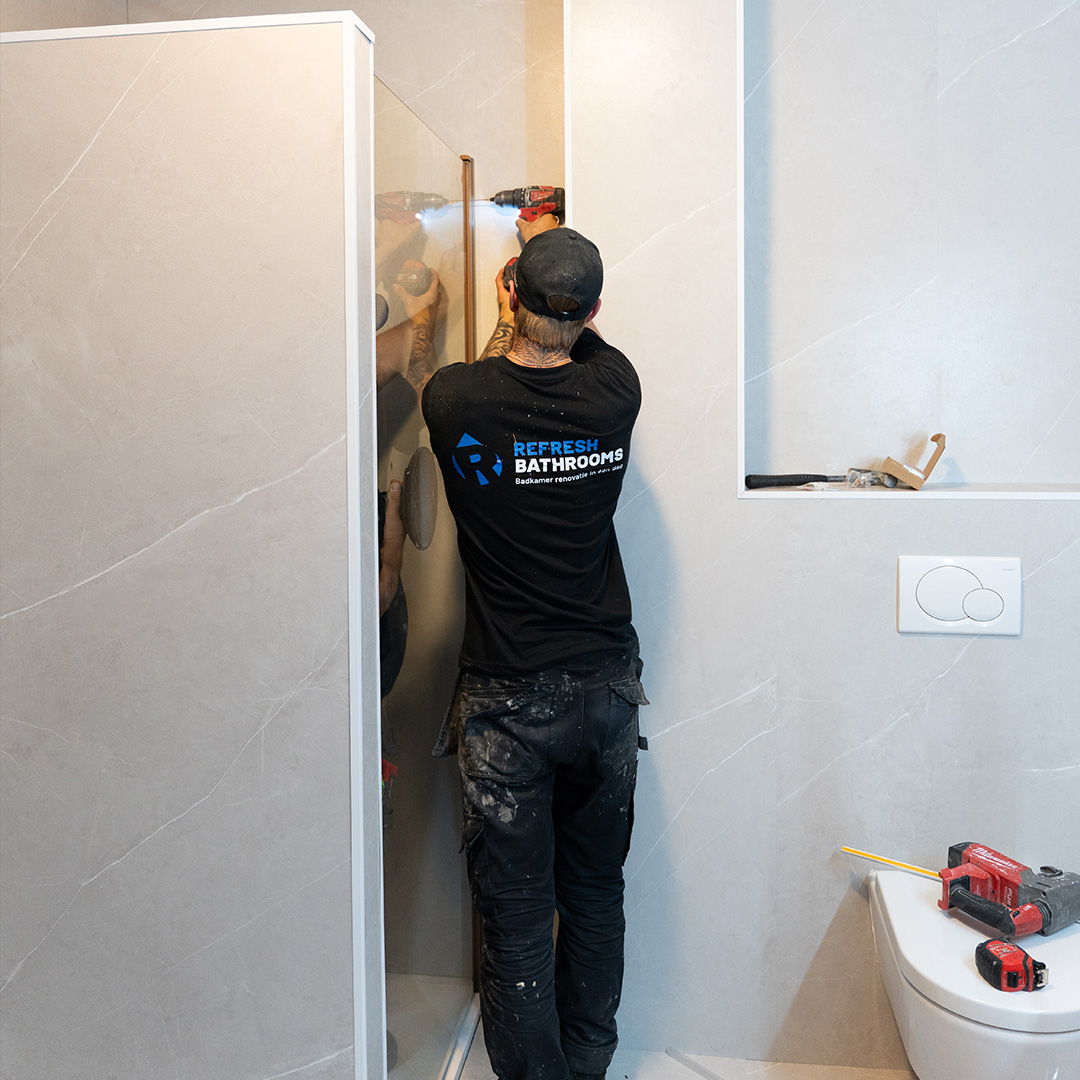
The labor costs for a bathroom renovation depend primarily on the amount of work involved, the chosen layout, and the number of trades required. If you want to create a realistic budget, you should therefore focus not just on the total cost of the bathroom, but rather on the specific tasks involved. On this page, you’ll learn which parts of the project require the most labor, when costs tend to rise, and what to look out for when reviewing a quote.
What are the labor costs involved in a bathroom renovation?
Labor costs are the costs associated with performing all the work required to renovate a bathroom. This includes dismantling the old bathroom, plumbing and electrical work, installing fixtures, wall and floor finishes, final assembly, and leaving the space in good order upon completion.
A complete renovation usually involves not just one, but several types of work. That is precisely why the labor component can vary significantly from project to project. A bathroom where the layout remains largely the same requires less work than one in which the shower, toilet, or sink is being moved.
Which tasks account for the largest share of labor costs?
Not every factor carries the same weight. In practice, these are usually the components that have the greatest impact on labor costs:
- Demolition of the old bathroom – removal of existing components and preparatory work
- Plumbing – modifying or connecting water lines and drains
- Electrical Work – Lighting, Outlets, and Other Electrical Features in the Bathroom
- Wall and Floor Finishing —a Labor-Intensive Part of Many Renovations
- Installation of bathroom fixtures —such as showers, bathtubs, toilets, vanities, and faucets
- Finishing and Completion – Final Assembly, Details, and Removal of Construction Debris
Piping work and changes to the layout, in particular, often result in additional hours. The more components that need to be moved or reassembled, the higher the labor costs usually turn out to be.
What has the greatest impact on the cost of labor?
1. The layout of the bathroom
Keeping the existing layout is often more budget-friendly. As soon as a shower, toilet, or sink is moved to a different location, the plumbing and drainage often need to be adjusted. That means extra work and, therefore, higher labor costs.
2. The scope of the renovation
A partial renovation typically requires less labor than a complete bathroom renovation. Simply replacing the fixtures is different from renovating the entire space, including finishing touches and technical adjustments.
3. The technical condition of the space
Old plumbing, outdated electrical systems, or hidden defects can result in additional work. That is why assessing the current condition is always important for a reliable cost estimate.
4. The chosen finish
The way walls and floors are finished has a significant impact on the amount of labor required. More preparation, precise fitting, and additional installation steps result in more work hours.
Hourly rate or flat fee: which is better?
When it comes to bathroom renovations, you’ll usually encounter two pricing models: an hourly rate or a fixed total price. An hourly rate seems straightforward, but with a complete bathroom renovation, it’s often harder to know exactly how much it will cost upfront. As soon as more work is needed than expected, the bill goes up.
A fixed price usually provides more clarity, provided the quote is well-detailed. Make sure it clearly specifies which services are and are not included. Consider items such as disassembly, connection work, finishing touches, and removal of materials. This will help you avoid a situation where a seemingly competitive price is later supplemented with additional charges.
Average bathroom renovation costs: What percentage of the total do labor costs account for?
The total cost of a bathroom consists of materials and labor. The exact proportion of labor varies from project to project. For a bathroom requiring extensive technical modifications or a completely new layout, the labor portion increases. For a renovation where many existing connections can be reused, that proportion is often lower.
At Refresh Bathrooms, a new bathroom—including installation—costs between €14,000 and €18,500 on average. This immediately shows why looking only at the total amount isn’t enough: within that total price, the nature of the work and the complexity of the project make a big difference. If you’d like to explore this further, you can also look at the average costs of a bathroom remodel. In addition, the comprehensive cost guide for a new bathroom (2025) provides insight into all cost drivers, including labor and materials.
When do labor costs increase significantly?
- When relocating plumbing fixtures —because the water supply, drainage, and sometimes electrical wiring must be moved along with them
- In the event of additional technical modifications —for example, when pipes or connections no longer meet the requirements
- In the case of a complete replacement —because more parts need to be removed and reinstalled
- When working with multiple independent contractors, coordination among the various parties can increase time and costs
That is precisely why it is important to conduct a thorough assessment beforehand. The more thoroughly the current situation is assessed, the less likely it is that surprises will arise during implementation.
How can you keep labor costs under control?
The best way to keep labor costs under control isn't necessarily to choose the lowest price, but to organize the work smartly. These choices are often the most helpful:
- Limit changes to the layout whenever practical
- Compare quotes based on content, not just the final amount
- Ask if installation, finishing, and cleanup are included
- Have the current situation thoroughly assessed in advance to minimize additional work
- Choose an approach that involves as little unnecessary chopping and breaking as possible—for example, a bathroom renovation without any demolition work—if that suits your bathroom and your preferences
Refresh Bathrooms offers complete bathroom renovations for homeowners, including installation by its own team of installers. Bathrooms are renovated with minimal demolition, in part by installing plastic composite wall panels over existing tiles. This can help make the project more efficient and minimize disruption. Read more about the costs and prices of bathroom wall panels (2026).
What should you look for when comparing quotes?
A good quote for a bathroom renovation is specific. You want to be able to see what work is included and where potential additional costs might arise. Be sure to pay attention to the following points:
- What services are included —from disassembly to finishing
- Whether plumbing and electrical work are included
- Whether removal and cleanup are included
- Whether the price is fixed or based on actual costs
- How are unforeseen tasks handled?
This way, you’re not comparing isolated total amounts, but rather the actual scope of the work. A practical checklist can help ensure you don’t overlook any important items.
FAQ on Labor Costs for a Bathroom Remodel
What is the hourly rate for a plumber working in a bathroom?
That varies by trade and by contractor. For a complete bathroom renovation, a fixed total price is often more useful than just an hourly rate, because multiple tasks and specialists together determine the final price.
How much does it cost to completely renovate a bathroom?
That depends on the size, layout, technical modifications, and finishing touches. At Refresh Bathrooms, a new bathroom, including installation, costs between €14,000 and €18,500 on average.
How much does a new 2-by-3-meter bathroom cost?
A 2-by-3-meter bathroom is fairly manageable in terms of size, but the final cost still depends heavily on the layout, the fixtures, and the necessary plumbing and installation work. So while the number of square meters is important, it’s not the only factor. If you want to avoid cost overruns in addition to keeping the price down, you might want to check out the option of a one-day bathroom renovation—how does it work?