Low Water Pressure in the Shower: Causes and Solutions
A weak shower stream doesn't automatically mean that the water pressure in your home is too low. In many cases, the problem lies closer to the shower itself—for example, in the showerhead, hose, faucet, or the hot-water side of the system. As a result, you can easily end up on the wrong track and replace parts unnecessarily.
The quickest way to find a solution is to first determine exactly where the problem lies: only in the shower, only with hot water, or throughout the entire house. With a simple bucket test and a few safety checks, you can rule out a lot of possibilities. That way, you’ll know more quickly whether you can fix it yourself or if you’re better off calling a plumber, the water utility, or the property manager.
Does the stream feel weak, or is the water pressure really too low?
When water pressure is low in the shower, it’s often not just a matter of the pressure in the pipe, but also the flow rate and the way the water comes out of the showerhead. Two showers can deliver the same amount of water, yet one may feel much more powerful than the other.
Pressure is the force with which water is delivered through the pipe. Flow rate is the actual amount of water that comes out of the shower per minute. A wide showerhead distributes that flow rate across more spray holes and therefore sometimes feels gentler. A compact, focused stream, on the other hand, often feels stronger, even if the actual amount of water remains the same. That’s why “poor water pressure” in the shower is often a combination of perception, flow, and local buildup, and not necessarily due to low household water pressure.
Here's how to identify the source of the problem
- First, compare the shower to other faucets in the house. If only the shower has low water pressure, the cause is often localized. If the kitchen faucet or bathroom sink faucet also have low water pressure, the problem is likely more widespread.
- Test the hot and cold water separately. If cold water flows normally but hot water has low pressure, check the mixer faucet, thermostat, or hot-water line before checking the main water supply.
- Pay attention to when the problem started. A sudden change is more often caused by maintenance work, a defective part, or a recent modification to the shower. A gradual decline is more often due to limescale or dirt.
- If you live in an apartment, ask your neighbors if they're experiencing the same thing. Shared systems, a central pressure system, or construction work in the building could be causing the issue.
- Also check to see if any maintenance has been performed on the water system recently. Sometimes low water pressure in the shower is temporary, and the cause lies outside the home.
Measure your shower's water output with the bucket test
| Step | What do you do? | What do the results show? |
|---|---|---|
| 1 | Set the shower to the setting you normally use and catch the water in a bucket. | You don't measure the perceived intensity of the spray, but the actual output. |
| 2 | Measure how many liters you collect in 30 seconds. | Multiply that number by 2 to get liters per minute. |
| 3 | Use the result as a rough guide. | A flow rate of less than about 6 l/min often feels too low; 6–9 l/min is usually sufficient for a water-saving showerhead; 9–12 l/min is generally more comfortable for a handheld showerhead. Large rain showers often require a higher flow rate. |
| 4 | If you're unsure about the water pressure in your home, try measuring it at an outdoor faucet or a washing machine faucet as well. | If the output is low there as well, then the problem is probably not limited to the shower. |
Limescale, dirt, a kink, or a flow restrictor: check the shower itself first
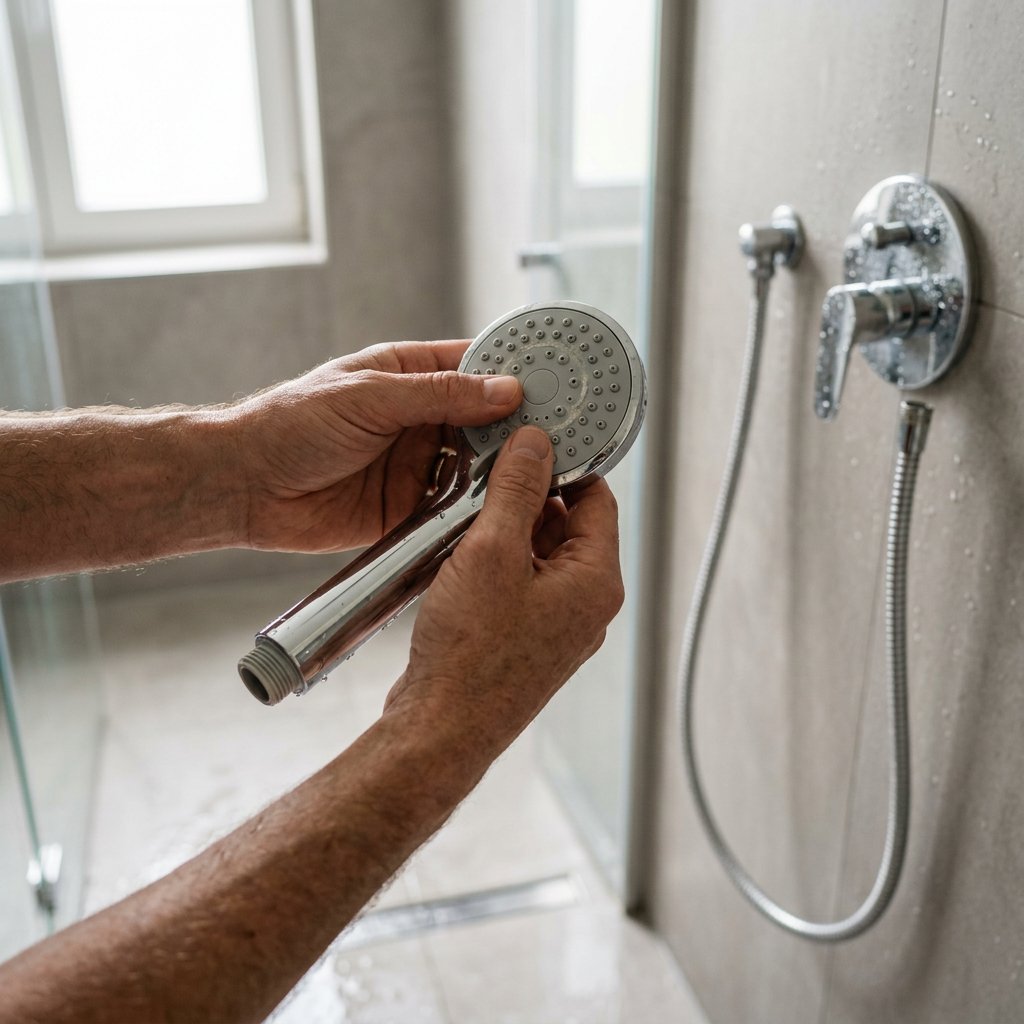
The most common cause of low water pressure from the showerhead is simple: limescale buildup in the spray holes, debris in the screens or filters, or a hose that is kinked or partially clogged. This restricts the flow, even if the water pressure from the main line is fine; often, the solution starts with removing the limescale.
Some showerheads also have a flow restrictor. This is intentionally installed and can make the water stream feel gentler. So try using a different showerhead or hose temporarily. That way, you’ll quickly see if the problem is actually with the shower itself. The brand is usually not the main reason; dirt buildup, wear and tear, and restrictions are much more common causes, and if the problem keeps coming back, renovating the shower might make more sense than simply replacing parts.
Only hot water and low pressure? Check the faucet and the hot-water side
If the cold water in the shower is fine but the hot water has low pressure, the problem is usually not related to the overall water pressure. In that case, the cause is more likely to be the mixer faucet, the thermostatic faucet, or the hot water supply that delivers the water.
Therefore, be sure to check other hot water outlets as well, such as the sink or kitchen faucet. If only the shower has low hot water pressure, the shower faucet or thermostat may be internally clogged or worn out. If multiple hot water outlets have reduced flow, there is likely an issue with the hot water line or the water heater.
Important: Central heating system pressure or boiler pressure is different from drinking water pressure. Topping off a central heating system is therefore usually not a solution for a weak shower. Also, do not attempt to tinker with gas-fired appliances, instant water heaters, or complex components of the district heating system on your own. In such cases, having a professional inspect the system is the safest option.
If you're planning a shower upgrade or renovation that requires improved water flow, you may need to adjust the plumbing and drainage.
Main valve, simultaneous use, or pressure loss in a building or neighborhood
Sometimes the problem isn't with the shower itself, but with the house or something outside it. A main valve that isn't fully open, multiple users at the same time, or temporary maintenance on the water system can all cause less water to reach the shower. Also consider situations where a washing machine is running while someone is showering.
This happens more often in apartments and on higher floors. In those cases, shared pipes, a central pressure system, or building-related limitations may be contributing factors. If you notice that your neighbors are having the same problem, it makes sense to first check with the homeowners’ association or property manager to see if there’s a malfunction or a known pressure issue.
A water pressure booster is only useful if there is a demonstrable, structural shortage. Such a solution won’t help if the real cause is a clogged showerhead, a faulty faucet, or a kinked hose. If you notice a loss of pressure at multiple faucets at the same time, or if there are service disruptions in the neighborhood, contact the water utility or the building manager before trying to fix the shower yourself.
Can a different showerhead help with low water pressure?
Yes, but not because the water pressure actually increases. A different showerhead can make the stream feel more powerful due to the size of the head, the spray pattern, and sometimes air injection. As a result, a shower with low pressure can still feel more pleasant.
Large rain showers, in particular, tend to be less impressive when the available water flow is limited. The same amount of water is then distributed over a larger surface area, making the spray feel gentler. In addition, larger shower sets often require more capacity from the plumbing and hot water supply than a compact hand shower.
Therefore, always check the product specifications and the required water flow rate before replacing a shower. This is especially important if you’re considering a rain shower or an elaborate shower set. When renovating a bathroom or installing a new walk-in shower, it’s wise to evaluate the shower type, plumbing, and hot water source together. Refresh Bathrooms takes this into account during renovation projects to ensure that the chosen shower setup matches the available water supply and daily usage.
What can you safely do on your own to improve your shower pressure?
- First, descale the showerhead and clean the spray holes, screens, and filters.
- Check the shower hose for kinks, wear, or dirt buildup, and replace it only if there is a valid reason to do so.
- Check the pipes and connections to see if anything is only partially closed or becoming clogged.
- Try comparing it temporarily with a different showerhead or hose. That way, you can test it systematically rather than just by feel.
- Check to see if the main valve is fully open and whether the problem also occurs when no water is being used elsewhere.
- Don't rush out to buy a new rain showerhead, pump, or thermostatic faucet without first measuring and comparing. Small, targeted tests usually yield better results than randomly replacing parts.
When should you call a plumber, water utility, or homeowners' association manager?
- Call a plumber if the problem is limited to the shower, if you suspect a faulty mixer or thermostatic faucet, or if the pipes or connections appear to be partially clogged.
- Contact the water utility if multiple faucets have low water pressure at the same time and you suspect there is a malfunction, maintenance, or pressure issue in the neighborhood.
- Contact the homeowners' association or property manager if neighbors are experiencing the same issue, or if the building uses a shared system, central pressure regulation, or a communal hot water supply.
- Do not attempt to troubleshoot gas appliances, hidden leaks, major pressure fluctuations, or recurring problems that have persisted after previous repairs on your own. In such cases, there’s a good chance the issue goes beyond just the showerhead.
- If there isn't an urgent problem but you do have a renovation question, a consultation is a better next step. For a malfunction, you'll need a plumber; for a planned renovation, you can have the shower setup designed right away to fit the available water supply.